
RelockIn lets its users vote on whether a YouTube channel makes AI-generated videos. When a channel gets enough AI votes, and a large enough share of all its votes say AI, it’s added to a shared list that RelockIn uses to label, cover or hide that channel’s videos, depending on what each person chooses. Votes are pseudonymous, a person reviews every channel before it can be covered or hidden, and anyone can dispute a label.
This post isn’t a how-to. It explains how the system is built, why we made the choices we did, and our answers to the fair objections people raise about it. Disclosure: I’m the founder of RelockIn, so read it as our side of the story, and check the code if you’d rather not take our word for it.
Why did we build AI voting?
Because a growing share of YouTube is made by channels that generate videos with AI, at volume, to farm views, and many people don’t want to spend their time on it. Feeds are full of AI-narrated “documentaries,” AI slideshows and AI music, and there’s no setting in YouTube to filter them out.
YouTube does ask creators to disclose realistic altered or synthetic content, but the disclosure is self-reported, it’s aimed at realistic content rather than AI production in general, and the label is easy to miss. It doesn’t help you if you simply don’t want AI-made videos in your feed.
RelockIn exists to make the internet less of a time sink, so letting people filter out AI content fit naturally alongside hiding Shorts and Reels.
Why votes instead of an AI detector?
Because AI detectors aren’t reliable enough to hide someone’s work on their say-so. They miss AI content, and they flag human work as AI. OpenAI withdrew its own AI text classifier in 2023 because of its low accuracy, and detecting AI voices, images and video across a whole channel is harder still.
We track AI content based on channels, not individual videos. AI channels usually upload with high frequency, so voting video by video would never keep up, and a channel’s ID never changes, unlike its name or handle.
The collective votes of a community can help catch what an AI detector would miss. Here are some giveaways to look out for:
- The channel uses an obvious text-to-speech voice
- The channel admits to using AI in its description
- The scripts are full of AI platitudes and cliches, or has factual inaccuracies or inconsistencies typical of a fully automated script
- The video uses obviously AI-generated images or videos
- The video uses a widely used or templated AI-animation style, often identifiable by visual glitches and by the exact animation style being shared by many other channels
- The channel posts content at a pace that would be impossible for a human team to produce
YouTube often posts small AI badges on videos that it detects have AI content. This can be used to inform our users' votes. RelockIn's AI channel list is necessary because these badges are often tiny or hidden and only show up on the video itself; our system helps flag AI videos before you click on them.
What counts as AI?
A channel counts as AI if most of its videos use one or more of these:
- An AI-written script. The words were generated, not written by a person.
- An AI voice. Text-to-speech or a cloned voice narrates instead of a person.
- AI-generated images or video. The visuals were generated rather than filmed, drawn or edited by people.
- AI music. The soundtrack, or the song itself, was generated.
These don’t count:
- Videos about AI. A review of an AI tool, a tutorial on prompting, or news about AI companies is made by a person talking about AI.
- Small AI touches. Noise removal, auto-generated captions, AI-assisted color correction, or a thumbnail made with an AI tool don’t make a channel AI.
- The occasional AI video. A creator who tries an AI video once isn’t an AI channel. It’s about what most of the channel’s videos are.
The gray area is real. A person who writes and records their own script but uses AI images for B-roll is somewhere in between, and different voters will see it differently. That’s one reason a channel needs a clear majority, not just a few votes, before anything happens.
How many votes does it take?
You vote right on YouTube. RelockIn adds AI and Not AI buttons under a channel’s name, next to an info button that explains what counts as AI.
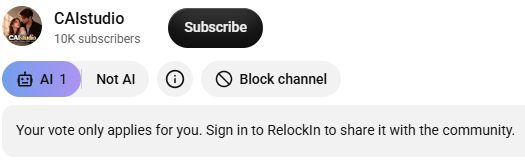
A channel is placed in a tier by the number of AI votes it has and the share of all its votes that say AI. Today the tiers are:
| Tier | AI votes needed | Share of votes that say AI | What happens |
|---|---|---|---|
| Possibly AI | 3 or more | At least 60% | A gray “AI?” label only. Never covered or hidden |
| Likely AI | 6 or more | At least 75% | Labeled, covered or hidden, as you choose |
| Very likely AI | 15 or more | At least 90% | Labeled, covered or hidden, as you choose |
| Disputed | 3 or more | 35% to 60% | Nothing changes in your feed |
So the bar for a channel to be covered or hidden is 6 AI votes, with at least 75% of all its votes saying AI. A channel with lots of AI votes but lots of Not AI votes too ends up Disputed, which has no effect.
These numbers aren’t fixed. They’re a starting point, and we’ll change them as more people vote and we learn where they get it wrong. If channels are being labeled too easily, or real AI channels are slipping through, we’ll adjust.
What does a label actually do?
That’s up to each person. In RelockIn’s YouTube settings, under Hide AI-generated videos?, you pick one of:
- Show: treat AI videos like any other video.
- Label: add an AI label to their thumbnails.
- Cover: blur them, with the option to show one anyway.
- Hide: remove them from feeds, search and recommendations.
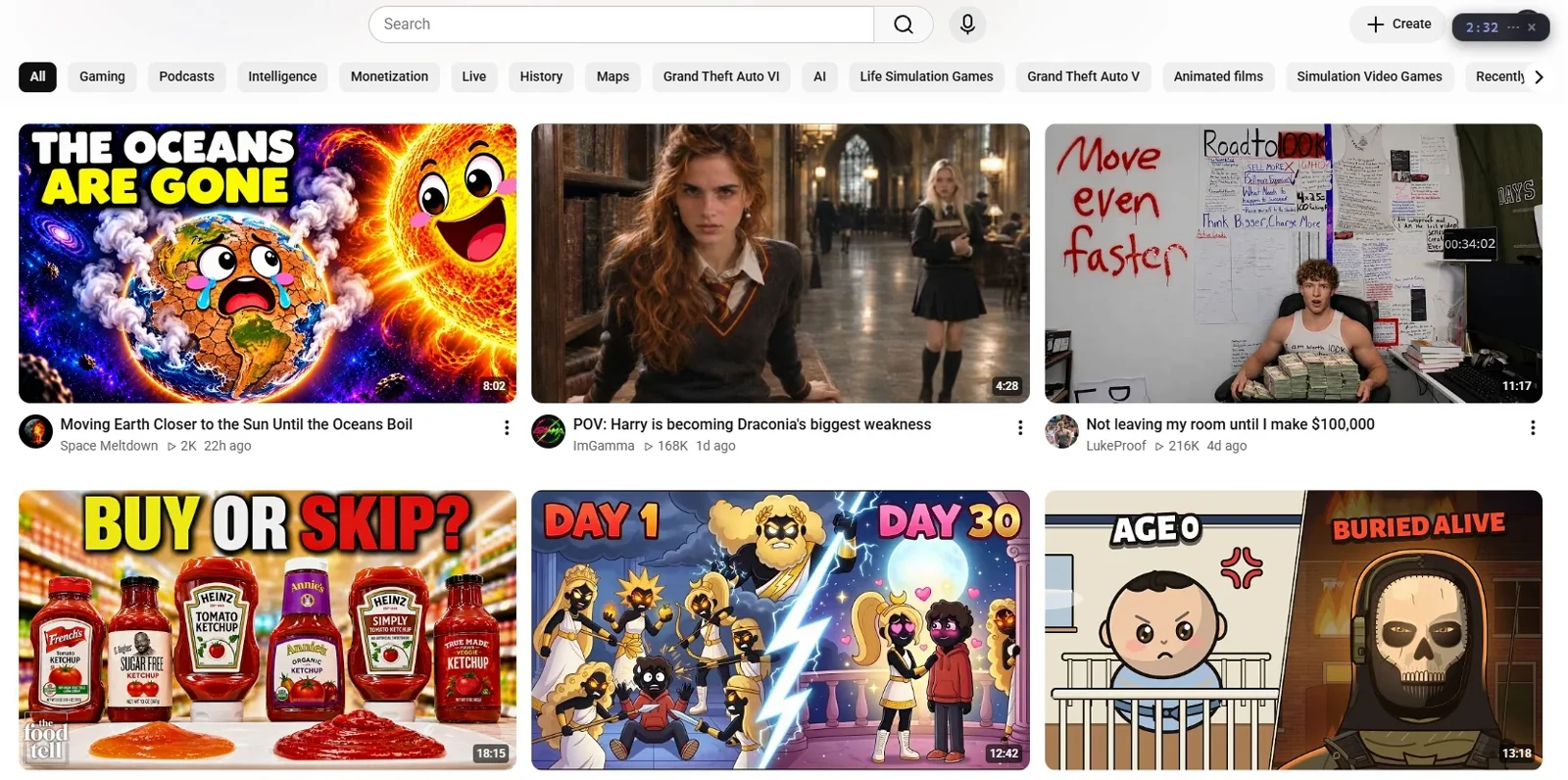
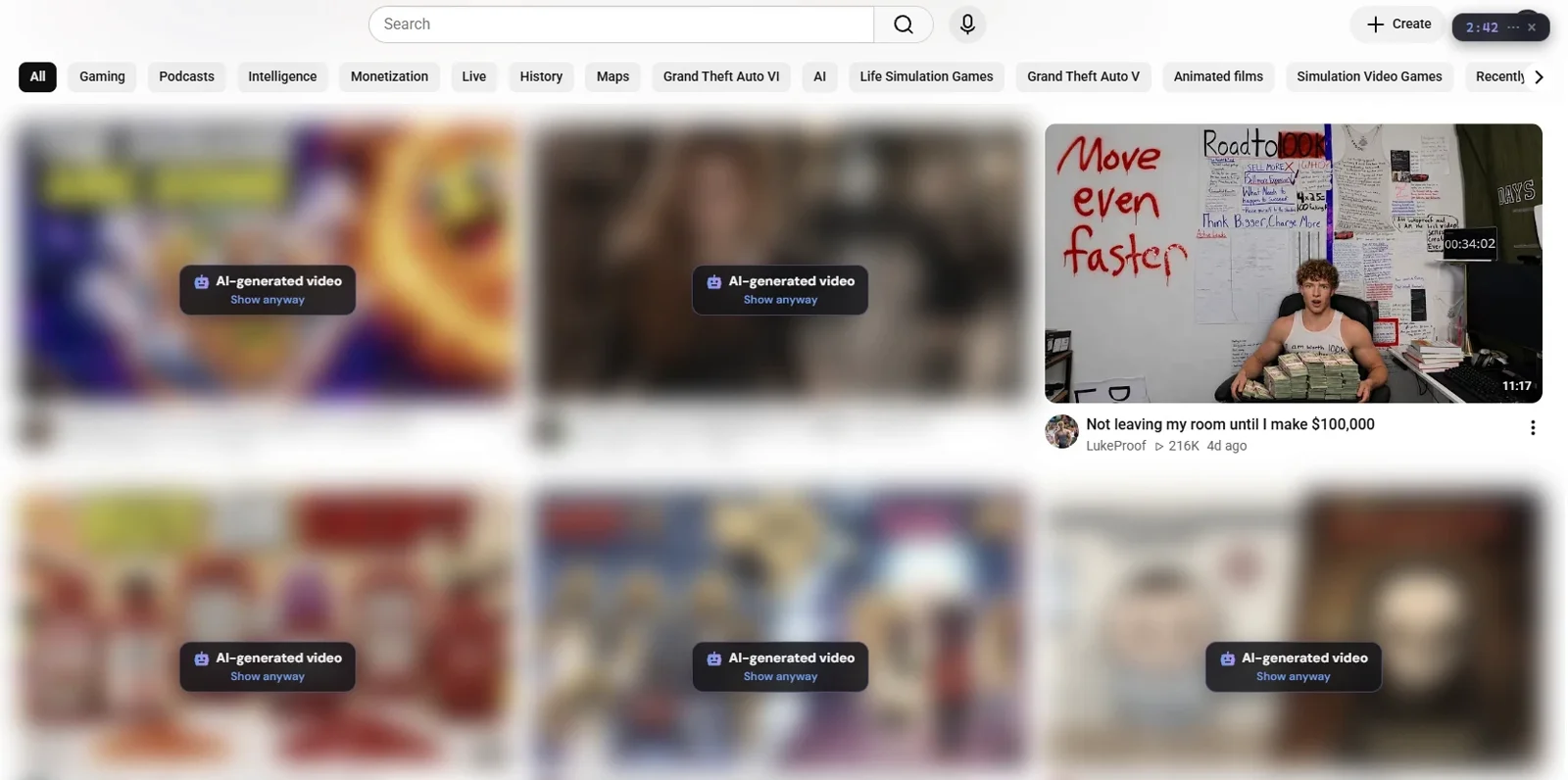
Nothing is deleted from YouTube, and nothing changes for people who don’t use RelockIn. Even with Hide on, you can still open the channel or video directly.
Your own votes also apply to you straight away. Vote a channel AI and it’s treated as AI for you immediately, whatever the shared list says. Vote it Not AI and it’s never treated as AI for you.
How are votes kept private?
Votes are pseudonymous. We don’t store your account ID next to your votes. Instead, each vote is stored under a voter code: a cryptographic hash (HMAC-SHA256) of your account ID, made with a secret key that’s kept separately from the vote tables in an encrypted vault.
What that means in practice:
- A copy of the vote tables can’t be traced back to people. If our vote data leaked, someone would see that some voter code voted on some channels, but couldn’t tell whose code it is without the secret key. They can’t work it out by trying account IDs either, because each guess needs the key.
- The same account is the same voter on every device. That’s what lets us keep one vote per account per channel, and enforce a daily limit, without storing who you are.
- Vote times are kept to the day. A vote’s date can’t be lined up with sign-ins or other logs to work out who cast it.
- We can still make the link on purpose, one account at a time. If you delete your account, we use the key to find and delete your votes. It’s also how we ignore an account’s votes if it’s abusing the system.
On top of that, RelockIn never learns what you watch. The app downloads the whole AI list and checks channels on your device. The only thing sent to us is the channel you vote on, when you vote while signed in.
We never publish who voted or how any person voted, and we don’t sell votes or use them for ads. The published list only contains channel IDs, tiers and vote totals. Our privacy policy has the details.
How do you stop people from gaming the votes?
With several layers, none of which is perfect alone:
- Only confirmed accounts count. You can vote signed out, but those votes stay on your device. To count toward the shared list, you need an account with a confirmed email, Google or Apple sign-in.
- One vote per account per channel. Changing your vote replaces the old one.
- A daily limit on how many votes an account can cast or change.
- Ratios, not just counts. To be labelled as AI, a channel must reach a threshold of consensus among our community (75% majority).
- We can quietly ignore accounts. If an account is mass-voting or brigading, its votes stop counting toward the list. It isn’t told, so it can’t simply switch tactics.
- Rules against abuse. Our Terms of Service ban bots, multiple accounts, coordinated voting, paying for votes, and voting on a channel for any reason other than whether it’s AI.
- A person reviews channels before they can be covered or hidden, and anyone can dispute the result.
What if a channel is labeled wrong?
Anyone can dispute a label: the channel’s creator, someone who works with them, or a viewer. There’s a “Label wrong? File a dispute” link in RelockIn’s AI voting panel, or you can go to the form directly. It works both ways: you can report a human channel labeled AI, or an AI channel that’s being missed.
A person on our team reads every dispute. We aim to decide within 7 days, and we’ll email you either way. Behind-the-scenes footage, project files or anything else that shows how the videos are made helps.
If we agree with a dispute, our review overrides the votes from then on. A channel we mark Not AI stays off the list however many AI votes it gets.
Common objections
“This will be used to brigade creators people don’t like.”
A channel needs a strong majority, not just a number of votes, so a group voting AI is cancelled out by real viewers voting Not AI. Brigading breaks our terms, we can silently ignore votes from accounts that do it. A real member of our team reviews channels before they’re covered or hidden, and the creator can appeal.
“People can get things wrong.”
They do, sometimes. That’s why nothing happens at 3 votes except a gray “AI?” label, why the bar for covering or hiding is a 75% majority, and why there’s a person reviewing and an appeal process on top. We’d rather miss some AI channels than wrongly hide a real creator.
The strongest label we have is "Very Likely AI". We never claim with absolute certainty that a video is or isn't AI, and we recommend our users cover or label AI videos rather than removing them entirely.
“Isn’t hiding someone’s videos unfair to them?”
RelockIn doesn’t remove anything from YouTube. It changes what one person sees, because that person asked it to, the same way choosing not to subscribe to a channel does. Each person decides whether AI channels are labeled, covered, hidden or shown as normal.
Additionally, RelockIn users can choose to just label or cover AI-generated videos rather than remove them entirely. That way, they still have the option of engaging with them, but stay informed about how they were made.
“What about creators who use AI responsibly?”
Using AI tools doesn’t make a channel AI. Cleaning up audio, generating captions or getting help with a thumbnail doesn’t count. The label is for channels where most videos are primarily made by AI: the script, the voice, the visuals or the music.
“Why should I trust you with my votes?”
You shouldn’t have to take our word for it, which is why the code is available to read and votes are stored pseudonymously. See the next section.
Can I check the code?
Yes. RelockIn is source-available: you can read the code, but it isn’t open source, so you can’t copy or redistribute it.
- The browser extension, including how it applies the AI list and sends votes, is public on GitHub.
- The iPhone and Android apps and the backend, including the database code that stores votes, works out tiers and builds the list, are available to anyone who applies to review them. A person reads each application.
We keep it source-available rather than open source to protect our users while security issues are found and fixed, to keep the code out of AI training data, and to stop it from being cloned. The source access page explains more.
What’s next?
Voting only covers YouTube channels today. We plan to bring it to other sites, such as Instagram and Facebook, and it will work the same way there. We’ll also keep tuning the thresholds, and as the list grows, we’ll look at how to keep a person in the loop without slowing it down.
If you spot a mistake, file a dispute. If you have feedback on how the system works, get in touch. You can try AI voting in the RelockIn app on iPhone and Android, or in RelockIn for Web on Chrome and Firefox.